Build Your Dream Ride with Mia
How To Tune ECU

Ed Little
•
Fabricator and Car Enrhusiast @ MOTORMIAYour ECU holds the key to unlocking performance that manufacturers deliberately left on the table. Welcome to the world of ECU tuning, where software modifications can transform your driving experience more dramatically than any bolt-on part.
Modern ECU tuning has evolved far beyond the chip swapping days of the 1990s. Today’s tools let you adjust thousands of parameters from your laptop, fine-tuning everything from throttle response to boost pressure.
The best part? You don’t need to be a qualified mechanic or pro tuner to get started. What you do need is respect for the power you’re wielding and willingness to learn from the massive community of enthusiasts who’ve already made the mistakes so you don’t have to.
Think of your ECU as an overprotective parent. It assumes you’ll use cheap gas, skip oil changes, and generally abuse your engine. These conservative settings work great for warranty coverage but terrible for enthusiasts seeking performance.
A proper tune removes these training wheels, optimizing parameters for your specific modifications, fuel quality, and driving style. We’re talking gains of 20 to 30 percent on turbocharged engines through software alone.
With the right approach and tools, enthusiasts are transforming their rides from their own driveways.
What Is ECU Tuning?
ECU tuning, short for Engine Control Unit, is the process of modifying a vehicle’s Engine Control Unit software to optimize performance parameters. This involves adjusting fuel maps, ignition timing, and boost pressure to increase horsepower and torque while maintaining engine reliability.
Your Engine Control Unit (ECU) is essentially a computer that tells your engine how to behave. It’s constantly making thousands of calculations per second like how much fuel to inject, when to fire the spark plugs, how much boost your turbo should produce.
ECU tuning means reprogramming these parameters to change how your engine performs.
The process involves accessing the software inside your ECU and modifying the data tables (called maps) that control various engine functions. These maps are like recipe cards that tell your engine exactly how to mix fuel and air under different conditions. Change the recipe, change the performance.
What makes ECU tuning so powerful is its precision. Unlike old-school modifications where you’d bolt on parts and hope for the best, ECU tuning lets you dial in exactly how you want your engine to respond. Want more low-end torque for towing? You can do that. Prefer screaming top-end power for track days? That’s possible too.
Modern ECUs are sophisticated enough to monitor and adjust hundreds of parameters in real-time. When you tune an ECU, you’re not just changing one thing – you’re optimizing the entire system to work together more effectively. It’s like conducting an orchestra where every instrument plays in perfect harmony, rather than just turning up the volume on the drums.
Benefits of ECU Tuning
Increased horsepower and torque
Raw power gains from ECU tuning can transform your vehicle’s personality entirely. Where bolt-on modifications might net you 5 to 10 horsepower, proper tuning unlocks 20 to 40 percent gains on turbocharged engines. Quality tunes improve the entire powerband, particularly the midrange where you actually drive.
Take a typical 2.0T engine found in everything from Volkswagens to Hyundais. Stock output hovers around 250 horsepower with boost tapering off above 5,000 RPM. A professional stage one tune pushes that same engine to 300+ horsepower while maintaining boost to redline.
The sensation goes beyond acceleration improvements. Power delivery becomes linear and predictable. Turbo lag diminishes. That flat spot at 3,500 RPM disappears. The breathless feeling approaching the redline gets replaced with a strong pull that begs you to bang the limiter.
Improved fuel economy
Here’s something manufacturers don’t want you knowing: properly tuned engines often achieve better fuel economy than stock. How’s that possible when you’re making more power? Easy. Stock tunes waste fuel through inefficient combustion strategies designed for worst-case scenarios.
Factory calibrations run rich mixtures under cruise conditions, dumping extra fuel as a safety margin. This excess fuel doesn’t contribute to power, instead washing oil off cylinder walls while killing catalytic converters prematurely. A proper tune optimizes air-fuel ratios for your specific fuel quality. Highway mileage improvements of 2 to 4 MPG are common after tuning, especially on turbocharged engines.
Enhanced throttle response
Nothing frustrates enthusiasts more than disconnected throttle response. You stab the gas expecting immediate reaction, but the engine thinks about it first. This delay stems from manufacturers softening throttle maps to prevent jerky driving.
ECU tuning strips away these training wheels. Throttle mapping becomes directly proportional to pedal position. Response time shrinks from hundreds of milliseconds to essentially instantaneous. The transformation affects every aspect of spirited driving. Heel-toe downshifts become natural. Corner exit speed improves. Even daily commuting becomes more enjoyable when your vehicle responds exactly as commanded.
Removal of factory limitations
Manufacturers build numerous electronic limitations into vehicles for reasons having nothing to do with mechanical capability. Speed limiters restrict top speed based on tire ratings for the base model. Rev limiters cut fuel unnecessarily early. Boost-by-gear tables prevent full power in lower gears to protect weak factory clutches.
Tuning removes these unnecessary restrictions, letting your modifications work as intended. Just remember that eliminating safety features makes you responsible for understanding component limits.
Customization for modifications
Perhaps tuning’s greatest value comes from optimizing for modifications you’ve installed. That expensive cold air intake flows 30 percent more air than stock, but your ECU doesn’t know this. The high-flow downpipe reduced exhaust backpressure significantly, but without retuning boost control, you’re not taking advantage.
Every modification creates unique requirements. Off-the-shelf tunes can’t account for these variations. Custom tuning optimizes for your specific setup, ensuring each component contributes maximum benefit while maintaining safe operation.
ECU Tuning Methods
OBD port remapping
The OBD port beneath your dashboard provides the most convenient access to ECU programming. This same port used for emissions testing offers full read/write access on most vehicles built after 2005. No ECU removal, no hood opening, just plug in and tune from the driver’s seat.
The simplicity makes OBD tuning perfect for enthusiasts starting their journey. Connect your interface cable between laptop and OBD port, launch the software, and you’re minutes away from reading your stock file. Speed represents another major advantage. Reading your complete ECU calibration takes 5 to 15 minutes. Writing modified files back takes similar time.
Bench tuning
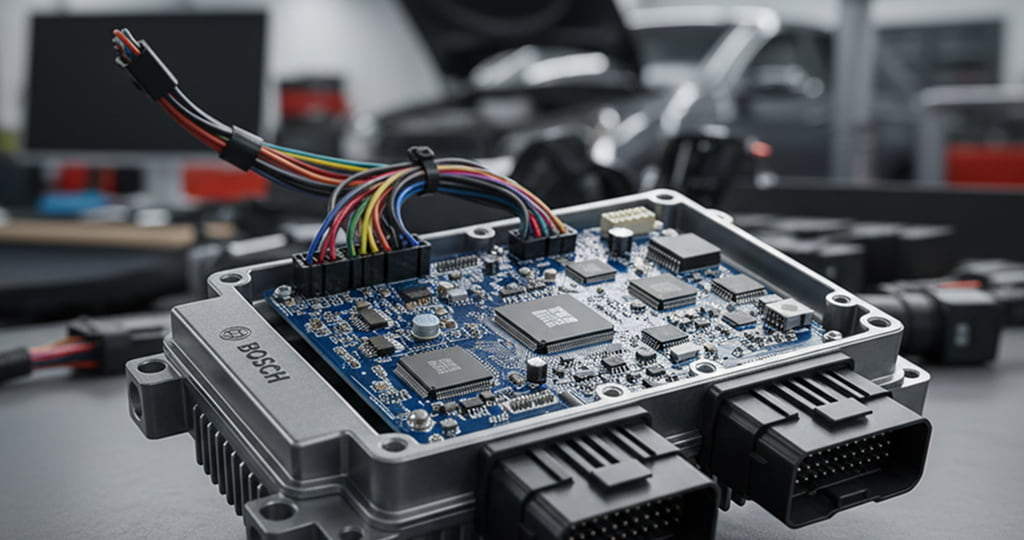
When OBD access isn’t available, bench tuning provides reliable alternatives. This method requires physically removing your ECU and connecting directly to the circuit board. While more complex than OBD methods, bench tuning can access otherwise locked ECUs.
The process starts with ECU removal, which varies from simple to frustrating depending on location. Once on your workbench, you’ll open the housing and connect specialized programmers to specific points on the circuit board. Modern bench tuning equipment has simplified what once required microscopic soldering skills.
Boot mode programming
Boot mode represents your last resort when other methods fail. This technique forces the ECU processor into emergency programming mode, bypassing normal security protocols. The process requires grounding specific pins while powering the ECU, with timing measured in milliseconds.
Why bother with such complexity? Boot mode provides access to protected memory areas other methods can’t reach. Professional tuners consider boot mode essential for working with exotic or heavily protected platforms.
Piggyback ECU systems
Not every solution requires modifying factory ECU software directly. Piggyback systems intercept sensor signals between engine and ECU, modifying values to achieve different behavior. Installation involves splicing into select sensor wires. The piggyback monitors signals like boost pressure, modifying them before they reach the ECU.
Modern piggyback systems go beyond simple signal modification. High-end units include their own processors and tuning software. For quick gains without laptop tuning, piggybacks deliver impressive results.
Standalone ECU replacement
When factory limitations become insurmountable, complete ECU replacement provides unlimited control. Standalone engine management systems abandon factory hardware entirely, purpose-built for maximum performance and tunability.
The complexity matches the capability. You’re rewiring the entire engine control system from scratch. But for serious builds pushing beyond factory architecture limits, standalones remain the only option.
Tools and equipment needed
Hardware Requirements
Getting started with ECU tuning demands specialized hardware. Your interface cable represents the most critical purchase, translating between laptop and ECU while handling various communication protocols.
Generic OBD cables sold for diagnostics lack the processing power required for ECU programming. Invest in quality cables designed specifically for tuning. Popular options include MPPS for European cars, HP Tuners MPVI2 for domestics, or Cobb Accessport for supported platforms. Budget $200 to $800 depending on features.
Your laptop becomes equally important. Aim for at least an i5 processor with 8GB RAM and solid-state storage. Ensure rock-solid USB ports. Power supply stability prevents countless issues. Connect a quality battery charger during all operations.
Software options
Tuning software ranges from free open-source solutions to professional suites costing thousands. Free tools like RomRaider provide basic functionality for learning. Mid-tier software like VCDS for Volkswagen/Audi allows parameter changes beyond basic code reading.
Professional software justifies its cost through depth and support. HP Tuners dominates domestic applications. Cobb, APR, and Unitronic offer refined interfaces for specific platforms. Expect $500 to $2,000 investment.
Diagnostic tools
Successful tuning requires understanding what your engine is actually doing. Quality OBD scanners form your diagnostic foundation. You need real-time logging of multiple parameters simultaneously.
Wideband oxygen sensors revolutionized DIY tuning by providing accurate air-fuel ratios. Budget $200 to $300 for quality kits. Boost gauges become mandatory for forced induction tuning.
Safety Equipment
Pushing engines harder demands respect for potential failures. Keep automotive-rated extinguishers within reach during all testing. Safety glasses protect against fluid sprays. Engine monitoring provides electronic safety nets with warnings for critical parameters.
Pre-tuning preparation
Vehicle health inspection
Before touching any software, verify your engine can handle tuning’s extra stress. Start with basics everyone ignores. When did you last change spark plugs? Old plugs cause misfires that become dangerous under boost.
Compression testing reveals internal health. Variations between cylinders indicate problems tuning will accelerate. Cooling system integrity becomes critical with added power. Pressure test everything. Replace old thermostats. Flush and refill coolant properly.
Baseline performance testing
Establishing objective baselines provides critical reference points. Dyno testing offers comprehensive data if budget allows. Street data logging provides accessible alternatives. Use your OBD scanner to record third and fourth gear pulls. GPS performance meters deliver repeatable acceleration testing.
Backing up factory settings
This step is non-negotiable. Your factory calibration represents your only path back to stock. Read your stock file multiple times, comparing checksums. Save copies everywhere using clear naming including VIN and date. Document everything about the backup process.
Understanding your ECU maps
Modern ECUs contain hundreds of tables controlling every aspect of operation. Start with main fuel and timing tables. Notice how manufacturers run rich mixtures and conservative timing. Compare base models to performance variants to see factory strategies. Boost control adds complexity on forced induction engines.
Step-by-step ECU tuning process
Step 1: Connect to your ECU
First contact sets the tone for everything following. Ensure stable power to both vehicle and laptop. Connect battery chargers and verify voltage. Turn off antivirus temporarily. Inspect OBD ports for bent pins. Connect cables firmly but gently. Select correct protocols in software. Initial handshaking takes time, so patience is key.
Step 2: Read current ECU file
Successfully reading your ECU marks a major milestone. Verify stable communication first. The process varies from minutes to half an hour. Monitor everything during reads. Once complete, verify file integrity. Save immediately with clear naming. Read again to ensure consistency.
Step 3: Analyze stock parameters
Detective work begins exploring manufacturer configurations. Fuel tables show rich mixtures for safety. Ignition timing proves even more conservative. Boost control analysis exposes obvious restrictions. Document all conservative strategies before making changes.
Step 4: Modify ECU maps
Map modification separates science from art. Start conservatively with fueling adjustments targeting 12.6:1 AFR under load. Add 2-3 degrees timing carefully while monitoring knock activity. Develop smooth boost curves your turbocharger can achieve. Adjust supporting tables that reference modified parameters.
Step 5: Upload modified file
Pre-flight checks catch most problems. Verify checksums match expectations. The upload process typically takes longer than reading. Never interrupt uploads. Monitor conditions carefully throughout. Post-upload verification confirms successful programming.
Step 6: Test and validate changes
Initial testing starts at idle, monitoring parameters for stability. First acceleration should be conservative third-gear pulls. Monitor air-fuel ratios for lean conditions. Data logging during varied driving reveals issues. Long-term validation matters most through oil analysis and plug checks.
FAQ
Why is it important to back up the original ECU data before tuning?
Backing up original ECU data creates a safety restore point for reversing modifications. This backup enables warranty preservation, troubleshooting failed tunes, passing emissions tests, and recovering from corrupted files during the tuning process.
What is the cost of ECU tuning?
Handheld tuners start around $400-600 with preloaded maps. Professional remote tuning runs $300-600. Professional software means a $750-2000 investment depending on the platform. Custom dyno tuning commands $400-1200 per session. Don’t forget hidden costs: widebands ($250), gauges ($200), and premium fuel forever.
Is ECU tuning difficult?
ECU tuning difficulty depends on the method chosen. Plug-and-play modules require minimal technical knowledge, while custom dyno tuning demands extensive engine calibration expertise. Most enthusiasts succeed with professional remote tuning services.
Success comes from starting simple and building knowledge gradually. Begin with low-risk modifications. Progress to fuel and timing changes as confidence grows.
Can you ECU tune yourself?
Yes, thousands of enthusiasts successfully tune their own vehicles. The tools and knowledge once professional secrets are now widely available. Self-tuning makes sense for popular platforms with strong community support. The investment pays dividends for multiple vehicles or ongoing modifications. Just remember that overriding factory safeguards makes you responsible for engine health monitoring.
Conclusion
ECU tuning bridges the gap between what manufacturers deliver and what your engine can actually achieve. Where previous generations swapped hard parts, you’re wielding precision tools that unlock performance through software optimization.
Your journey starts with deciding to stop accepting factory limitations. Whether loading proven tunes tomorrow or crafting custom calibrations, you’re joining enthusiasts who refuse to leave performance on the table. The tools available today would seem like magic to tuners from a decade ago.
Success comes from respecting both power and responsibility. Those conservative factory tunes exist for good reasons. When you override them, you become responsible for monitoring engine health, using quality fuel, and maintaining cooling systems religiously. The reward? Driving a vehicle optimized specifically for your needs.
Start small, document everything, and never stop learning. The destination might be a faster car, but the real satisfaction comes from understanding and mastering the technology that makes it possible.
Join our community of enthusiasts documenting their own journey and learn from the progress of others.